In The Loop
Projects that use PyImageLabeling.
TransMAG — Pancreatic Cancer (2024–2026)
Segmentation and labeling of medical images for the study of pancreatic cancer, as part of a MAIA PhD thesis.
Overview
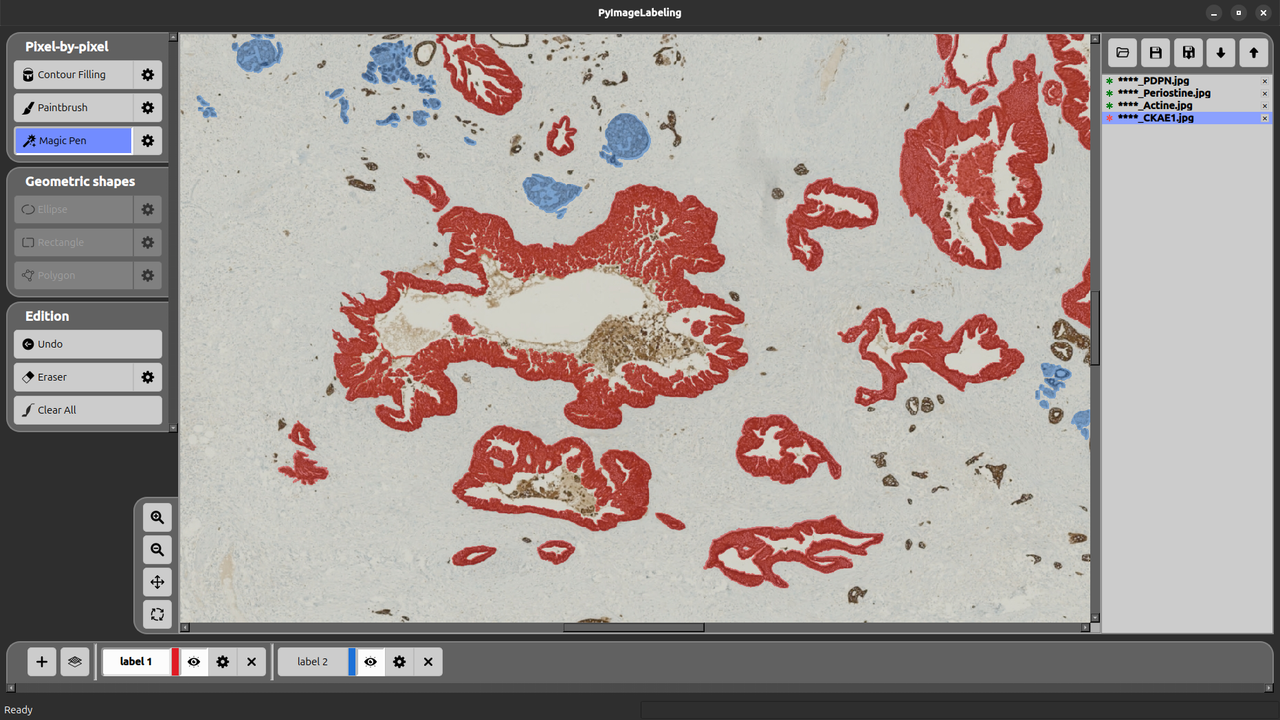
Pancreatic ductal adenocarcinoma is one of the deadliest cancers, with a five-year survival rate of around 11%. Its poor prognosis is largely driven by a dense fibrous stroma, in which cancer-associated fibroblasts (CAFs) play a central role in tumour aggressiveness.
This project applies artificial intelligence to identify new diagnostic and prognostic biomarkers, by teaching models to recognise cell types (epithelial vs. CAF) and their tumoural context from immunohistochemistry images of specific marker expression (αSMA, POSTN, PDPN, and the magnesium transporters TRPM7 and CNNM4). Machine-learning models are trained to classify the cells, and explainable AI (XAI, using the PyXAI library) then reveals which markers drive cancer aggressiveness.
The first and most critical step is building a reliable, expert-annotated dataset of tens of thousands of cells, drawn from multiple co-registered marker images of the same tissue. This workflow — selecting individual cells, propagating each annotation across aligned multi-marker images, and producing a balanced dataset for classification — is supported by PyImageLabeling. It lets pathologists annotate cells efficiently and includes a real-time, ML-assisted labeling mode that speeds up annotation as the dataset grows, making the construction of a large, high-quality training set feasible.
People Involved
- Laboratories: CRCLille (UMR9020 CNRS) · CRIL (UMR 8188) · CHU-Amiens-Picardie
- Collaborators:
- Isabelle Dhennin
- Pierre-Marie Fayette
- Mathieu Gautier
- Mouny Samy Modeliar
- Laure Noe (PhD student)
- Nicolas Szczepanski